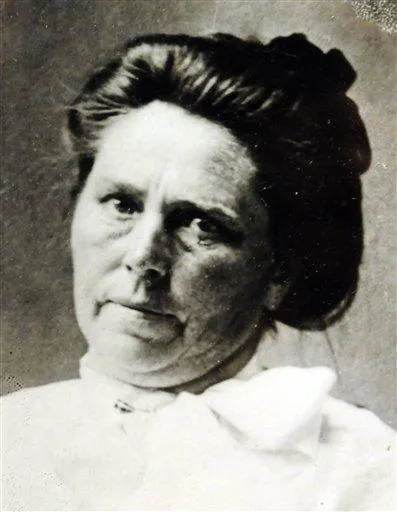
For years, men from across the Midwest answered the newspaper ads of a wealthy Norwegian widow looking for a husband. They packed their savings, traveled to her farm in La Porte, Indiana, and vanished.
Only after her farmhouse burned to the ground in April 1908 did anyone start digging. What they found in the mud of her hog pen made Belle Gunness one of the most notorious killers in American history. More than a century later, no one can say for certain what happened to her.
Who Was Belle Gunness?
She was born Brynhild Paulsdatter Størseth on November 11, 1859, in Selbu, Norway, the youngest of eight children. As a teenager she worked on farms to save money, and in 1881 she emigrated to the United States. Her name was recorded as “Belle” when she arrived, and she settled in Chicago near her sister, working as a servant.
In 1884 she married Mads Sørensen. The couple ran a candy store that later burned down, and their house also caught fire. Both fires paid out insurance. Two infants in the family’s care died while they were young. Belle had insured them too.
On July 30, 1900, Mads Sørensen died suddenly. Belle said he came home with a headache and she gave him quinine powder. It happened to be the one day on which two of his life insurance policies overlapped: one was expiring and the other was taking effect. Belle collected $5,000 from both and used the money to buy a pig farm on the edge of La Porte, Indiana.
A Second Husband, A Second “Accident”
On April 1, 1902, Belle married a Norwegian widower named Peter Gunness. About a week later, his infant daughter died of unknown causes while in Belle’s care.
Eight months after the wedding, Peter Gunness was dead too, killed by a blow to the skull. Belle explained that a meat grinder had fallen on him from a high shelf. A coroner’s jury suspected murder but took no action, and Belle collected $3,000 in insurance.
The Lonely-Hearts Ads
Beginning around 1905, Belle placed marriage ads in Chicago newspapers, presenting herself as a well-off widow looking for a companion.
One of the men who answered was Henry Gurholt, a farmhand from Wisconsin. After arriving in La Porte, he wrote home saying he liked the farm and was in good health. It was the last letter his family received. When they asked Belle about him, she said he had left for Chicago with some horse traders. She kept his trunk and his fur coat.
In 1906, John Moe of Minnesota answered another ad. After months of letters, he withdrew a large sum of cash and traveled to La Porte. He was never seen again. A carpenter who worked at the farm later recalled seeing more than a dozen trunks in Belle’s house.
The Fire
In the early morning of April 28, 1908, the Gunness farmhouse burned to the ground. In the basement, searchers found four bodies. Three were Belle’s children: Myrtle, Lucy and Philip. The fourth was an adult woman who could not be identified.
Most people assumed the woman was Belle. The case might have ended there if not for Asle Helgelien.
What They Found In The Hog Pen
Asle’s brother Andrew had been writing to Belle. Her letters urged him to come to La Porte, bring his money, and keep the trip a secret. Andrew went and never returned.
Asle came to the farm with a former hired hand, who pointed out soft depressions in the ground where the hog pen had been. When they dug, they found his brother’s remains.
Searchers kept digging. They found five victims on the first day and six more on the second. Most could never be identified. According to accounts of the search, the police eventually stopped counting.
Was It Really Belle In The Fire?
The unidentified woman in the basement soon became a mystery of her own. Dr. Harry Long, who had known Belle, examined the body and insisted it was not hers. It was much lighter and several inches shorter than Belle, who was a large, heavy-set woman, and it had neatly manicured fingernails.
“It is not that of Mrs. Gunness. I am sure of that.” (Dr. Harry Long, May 1908)
On the other side, Belle’s dentist identified a gold dental crown found in the ashes as work he had done for her. Rings found with the body also appeared to be hers. The woman’s identity was never conclusively established.
The Hired Hand
Suspicion quickly fell on Ray Lamphere, Belle’s hired hand and on-and-off lover. When he was arrested, he was reportedly wearing John Moe’s overcoat and carrying Henry Gurholt’s watch.
In November 1908, a jury convicted Lamphere of arson but not murder. He later claimed Belle had lured men with her ads in order to rob and kill them, that she had asked him to help burn the house, and that the headless body was another victim, planted so Belle could fake her own death and escape.
Lamphere developed tuberculosis in prison and died on December 30, 1909.
What Happened To Belle Gunness?
Reported sightings of Belle continued for years after the fire. The farm, meanwhile, became a grim tourist attraction, with crowds buying souvenirs at the site.
In 2008, a century after the fire, researchers tried to compare DNA from the unidentified woman with DNA from a letter Belle had sent to one of her victims. The sample was too degraded to give an answer.
Belle Gunness is believed to have killed at least 14 people, mostly men who answered her ads, and some estimates run as high as 40. Her motive appears to have been money: insurance payouts and the savings her victims brought with them.
After reading about Belle Gunness, learn about H. H. Holmes, the con man who killed for insurance money in 1890s Chicago. Then, read about the Bloody Benders, the Kansas family whose roadside inn became a death trap.