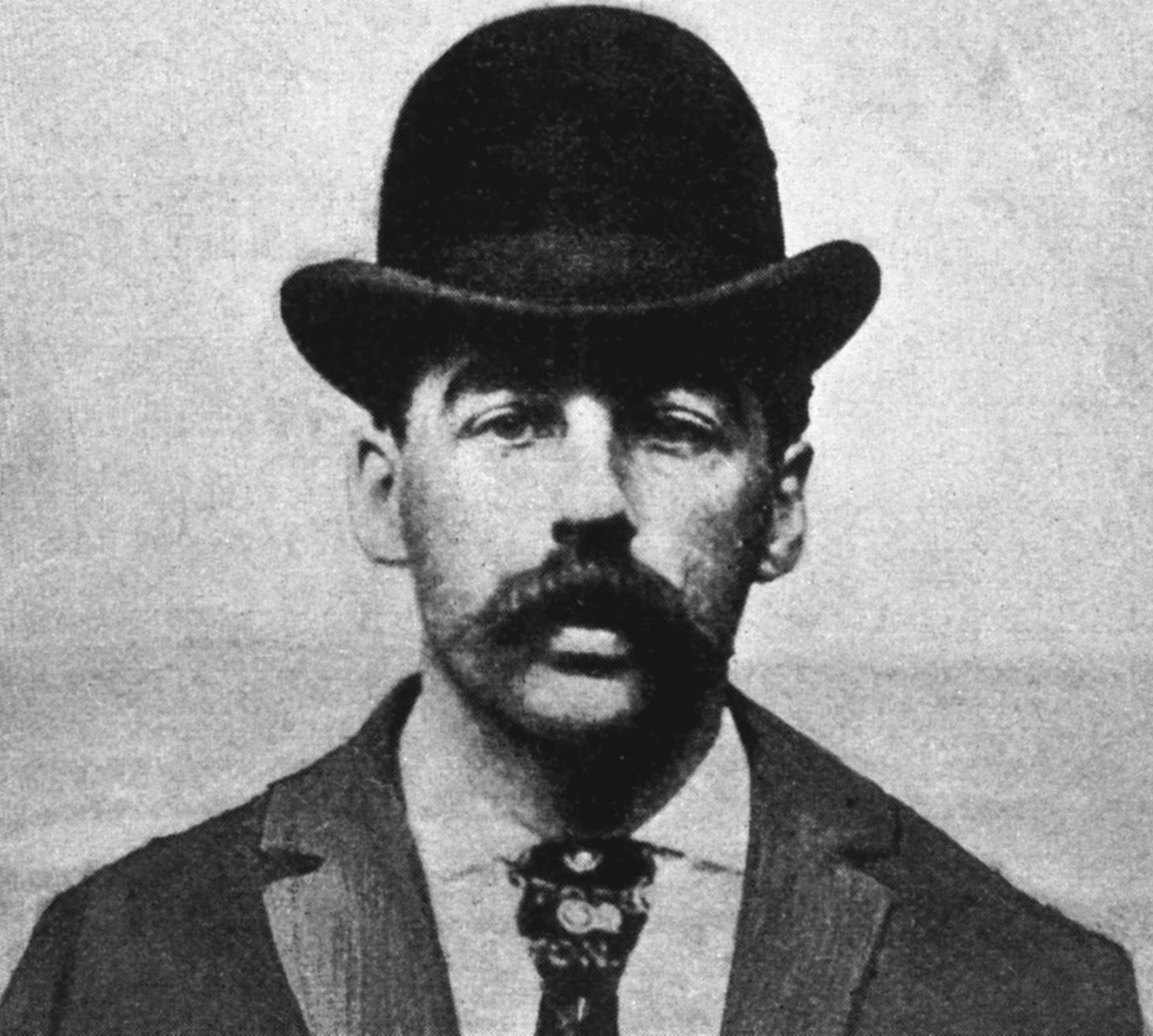
H. H. Holmes is often called America’s first serial killer. Legend says he built a “murder castle” in Chicago, full of trapdoors, gas chambers and secret crematoriums, where he killed hundreds of visitors to the 1893 World’s Fair.
Much of that legend comes from sensational newspapers of the 1890s, and historians have found little evidence for it. The verified story is different. It is about a con man who treated murder as part of his business, and a detective who would not give up.
Who Was H. H. Holmes?
He was born Herman Webster Mudgett on May 16, 1861, in Gilmanton, New Hampshire. He studied medicine at the University of Michigan and graduated in 1884. He later admitted that as a student he had used cadavers to cheat life insurance companies.
After drifting through several states, he arrived in Chicago in 1886 under a new name, Henry Howard Holmes. He took over a drugstore at 63rd Street and Wallace Avenue in the Englewood neighborhood, then began putting up a building across the street.
The “Murder Castle”
Holmes’s building became famous as the “Murder Castle.” Newspapers published floor plans showing secret rooms and hidden chutes. According to historians who have studied the records, the real building was a fairly ordinary, unfinished structure of stores and rooms. Its hidden spaces were most likely used to hide furniture Holmes had bought on credit and never paid for.
That doesn’t mean Holmes was innocent. Author Adam Selzer, who has researched the case closely, argues that Holmes killed for profit rather than for the love of it. In his words, the murders were “a necessary part of furthering his swindling operation.”
The Victims
Historians consider nine murders confirmed. On Christmas Eve 1891, Julia Conner and her daughter Pearl, who was about five, disappeared. Julia had been Holmes’s mistress. His secretary, 23-year-old Emeline Cigrand, disappeared at the end of 1892.
In 1893, Holmes became involved with Minnie Williams, who signed a Texas property deed over to him. Her 18-year-old sister Anna came to visit that summer. In July 1893 Anna wrote to her aunt that “Brother Harry” would take care of her. Neither sister was seen alive again.
The Insurance Scheme
Holmes’s longtime associate was Benjamin Pitezel, a carpenter. Together they planned an insurance fraud: Pitezel would fake his own death in Philadelphia, and they would split a $10,000 life insurance payout.
Instead, in early September 1894, Holmes killed Pitezel for real. His body was found at 1326 Callowhill Street, staged to look like an accident.
Holmes then convinced Pitezel’s wife, Carrie, that her husband was still alive and in hiding, and persuaded her to let him take three of her children: Alice, 13, Nellie, 9, and Howard, 7. He moved the children from city to city while leading Carrie along a separate route, lying to her about where her husband and children were.
The Detective Who Caught Him
Holmes was arrested in Boston on November 17, 1894, and was first held on an old warrant for horse theft in Texas. The fate of the Pitezel children was unknown.
In June 1895, Philadelphia police detective Frank Geyer began retracing Holmes’s steps through the Midwest and into Canada. In Toronto, he found a house Holmes had rented, and a search of its cellar confirmed his worst fear: Alice and Nellie Pitezel had been killed there.
Geyer kept searching and later found evidence that their brother Howard had been killed in a house Holmes had rented near Indianapolis. His painstaking work turned a fraud case into a murder case. He later told the story in his own book, The Holmes-Pitezel Case.
Trial, Confession And Execution
In 1895, a Philadelphia jury convicted Holmes of murdering Benjamin Pitezel, and he was sentenced to death. While awaiting execution, he sold a confession to Hearst newspapers for a reported $7,500, claiming 27 murders.
Much of that confession turned out to be false. At least one of the people he claimed to have killed later turned up alive and said so publicly.
Holmes was hanged at Moyamensing Prison in Philadelphia on May 7, 1896. Fearing grave robbers, he asked to be buried in concrete, 10 feet down. When his body was exhumed for testing in 2017, researchers confirmed through his teeth that the man in the grave was Holmes.
How Many Did He Really Kill?
Nine victims are confirmed. Holmes is suspected of more, but claims of 100 or 200 victims have no solid evidence behind them. Researchers put them down largely to poor police work at the time and the yellow journalism that followed.
After reading about H. H. Holmes, learn about Belle Gunness, the Indiana widow who lured suitors to her farm. Then, read about D. B. Cooper, the hijacker who jumped from a plane with $200,000 and vanished.